Published December 18, 2025
Why Tech Corridor Sellers Are Quietly Re-Entering the Market

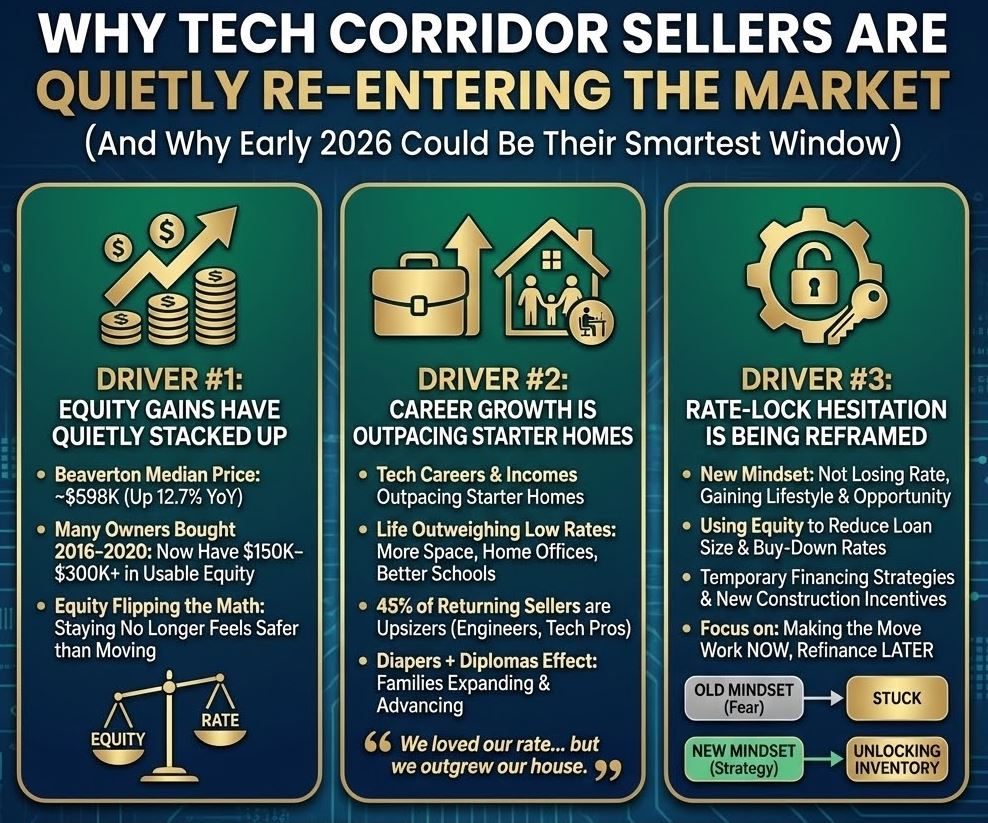
 Why Tech Corridor Sellers Are Quietly Re-Entering the Market
(And Why Early 2026 Could Be Their Smartest Window)
Something interesting is happening across Portland’s Tech Corridor — and it’s not being talked about loudly.
Homeowners in Beaverton, Hillsboro, Orenco Station, Five Oaks, Cedar Hills, and areas near MAX lines are starting to list their homes again.
Not in a rush.
Not out of panic.
But very intentionally.
As we close out 2025 and look ahead to early 2026, tech-driven sellers are finally moving past the “rate-lock freeze” that kept them stuck for the last two years — and the reasons are both financial and emotional.
Let’s unpack what’s really driving this shift.
 The Big Picture: The Rate-Lock Era Is Cracking
For much of 2023–2025, Portland’s Tech Corridor was defined by hesitation.
Thousands of homeowners held onto:
- 2.75%–3.5% mortgage rates
- Starter homes bought pre- or mid-pandemic
- Strong jobs but uncertain timing
This created what the industry called the “rate-lock effect.”
But as we head into 2026, that lock is loosening — fast.
According to recent Portland Metro analysis, nearly 2 in 3 potential sellers have been thinking about moving for over a year, but delayed due to rate fear rather than lack of motivation.
Now, something has changed.
 Driver #1: Equity Gains Have Quietly Stacked Up
One of the most overlooked truths in today’s market?
Tech Corridor homeowners are sitting on far more equity than they realize.
In Beaverton alone:
- Median home price reached $598,000
- Up 12.7% year-over-year
- Many owners bought between 2016–2020 at $350K–$450K price points
That means a large portion of tech homeowners now have:
- $150K–$300K+ in usable equity
- The ability to put strong down payments on move-up homes
- Flexibility to offset higher rates with cash positioning
For many sellers, the math has finally flipped:
“Staying no longer feels safer than moving.”
 Driver #2: Career Growth Is Outpacing Starter Homes
Tech careers don’t stand still — and housing needs don’t either.
Across the Beaverton–Hillsboro corridor, the primary seller profile returning to market is the Upsizer, representing roughly 45% of anticipated listings.
These sellers share common traits:
- Engineers and tech professionals
- Significant income growth over the last 3–5 years
- Families expanding (the “diapers + diplomas” effect)
- Homes that no longer fit their lifestyle or work-from-home needs
What changed in 2025?
Life finally outweighed the low rate.
More space.
Home offices.
Better school alignment.
Proximity to amenities.
A home that matches where they are now, not who they were in 2019.
As one seller recently told me:
“We loved our rate… but we outgrew our house.”
 Driver #3: Rate-Lock Hesitation Is Being Reframed (Not Ignored)
Tech sellers aren’t reckless — they’re analytical.
They didn’t suddenly forget about interest rates.
They simply stopped letting rates be the only variable.
Here’s how thinking has evolved:
Old mindset:
“If I sell, I lose my rate.”
New mindset:
“If I don’t sell, I lose time, lifestyle, and opportunity.”
Many sellers are now using:
- Equity to reduce loan size
- Rate buy-downs on the buy side
- New construction incentives
- Temporary financing strategies
Instead of waiting for “perfect rates,” they’re asking:
“How do I make the move work now and refinance later?”
That psychological shift is unlocking inventory across the Tech Corridor.
 Why the Tech Corridor Specifically Is Leading This Shift
Not all Portland neighborhoods are seeing this behavior — but Beaverton & Hillsboro are out front.
Why?
 Strong employment base
Intel, Nike (nearby), and the broader Silicon Forest continue to drive consistent job movement and relocations.
Transit-oriented demand
Homes near MAX lines and infrastructure upgrades are seeing reliable buyer interest, giving sellers confidence they won’t “miss the market”.
Clear move-up pathways
Starter homes in the $400K–$550K range → move-up homes in the $600K–$800K range remain achievable with equity.
New development competition
Communities like Reed’s Crossing are pulling buyers west — motivating resale sellers nearby to act while demand is strong.
 Why End of 2025 → Early 2026 Is the Sweet Spot
Historically, many sellers wait for spring.
But tech-corridor sellers re-entering between December and February often gain advantages:
 Less competition
Inventory is still below spring levels.
Serious buyers only
Relocation buyers, career movers, and planners are active now.
Cleaner pricing signals
Less noise = more realistic offers.
Better positioning for move-up buys
Selling before the spring rush gives sellers leverage on their next purchase.
According to recent market analysis, inventory normalization — not oversupply — is the theme heading into 2026.
 What This Means for Tech Corridor Sellers
If you’re a homeowner in Beaverton, Hillsboro, or nearby tech-driven neighborhoods, this moment matters.
The sellers winning right now are:
- Leveraging equity, not fearing rates
- Planning moves strategically, not emotionally
- Selling from a position of strength
- Timing the market locally, not nationally
They understand one thing:
Markets don’t reopen with headlines — they reopen quietly.
And that’s exactly what’s happening now.
 Looking Ahead to 2026
As we move into the new year, expect:
- Continued seller re-entry tied to life changes
- Strong buyer demand tied to tech employment
- More listings — but not a flood
- A balanced, opportunity-rich market for prepared sellers
The Tech Corridor isn’t heating up because sellers are desperate.
It’s heating up because they’re ready.
 Final Thoughts
If you’ve been sitting on the fence — watching rates, watching headlines, watching your life evolve — you’re not alone.
But many tech-corridor homeowners are realizing:
The right time to move isn’t when rates are perfect.
It’s when your life says it’s time.
 DM me or comment below and I’ll send you my Tech Corridor Equity & Timing Report — a personalized breakdown showing:
- Your estimated equity position
- Local buyer demand
- Smart move-up strategies for early 2026
- How sellers are navigating rates without waiting
Let’s turn hesitation into a plan — and make 2026 a strategic step forward.